Steve's notation of The Beach Boys as one of the great American bands of the sixties raised my eyebrows a bit. I have some issues with the Beach Boys: my former mother-in-law used to say they were white supremacists. That may be a bit strong: she was sort of a crazy person. But any rumination on Brian Wilson can't necessarily use that as a dismissal.
Any claim the Beach Boys have to fame begins and ends with Wilson, Mike Love's whiny insistence that it's his group too notwithstanding. But the complications of accepting Wilson's artistic centrality as a composer and producer are obviously pretty significant. I mean, they began as dad's project for the boys, no? And surf music was a calculted attempt to catch a trend that they personally had nothing to do with, simply an economic decision. They did outgrow surf music, of course, and there were a few years there, the Pet Sounds and SMiLE years (SMiLE, of course, listed more honestly as Wilson solo, not The Beach Boys), but that quickly declined into Howard Hughes-style mania for Brian. So he had a good period there, but is that enough? And I don't mean to pick on the guy: it might be, for most people. But I'm just assuming Simels meant Pet Sounds Beach Boys and not, say, "Be True to Your School" Beach Boys. I'll ask him to clarify.
(And no, to answer the inevitable question, I don't much credit "Kokomo," one of the most dependably annoying songs of the last century. I've been to Indiana, there's nothing tropical about it. But I do quite like The Barenaked Ladies song "Brian Wilson," if that helps.)
Worth noting: Matt Dillon's performance as Wilson in Grace of My Heart, an underrated film. (And Jeff and Steve McDonald play the Beach Boys who, when the Dillon character reveals his version of "Good Vibrations" ask, "How do you play it live?")
Tuesday, January 31, 2006

The Horror, The Horror!
Look, everyone who knows Eli understands that he is a force of nature. With his intrepid sidekick Codename V, he relentlessly sifts through the detrious of the internets to find, well, the worst things ever. I'm talking here about things like He-Man cartoons of Four Non-Blonde songs, that sort of thing. Terrifying. Fascinating.
But even by Eli standards, this is dismaying.
Devo 2.0.
I'll be over here in a fetal position, sucking my thumb. Don't mind me.
But even by Eli standards, this is dismaying.
Devo 2.0.
I'll be over here in a fetal position, sucking my thumb. Don't mind me.
Sunday, January 29, 2006
Rosie Battles the Red Robot
This week we acquired a robotic vacuum cleaner called a Roomba. It's kind of cool, though it meanders worse than a Bush nonanswer about a topic he doesn't understand. So it takes a while to actually clean. Thers resisted, because he thought our kids would be so fascinated that they'd break it the first day. Not quite, though he was right about the fascination, as the folowing photos demonstrate.

Rosie contemplates what to do with the robotic vaccum cleaner.
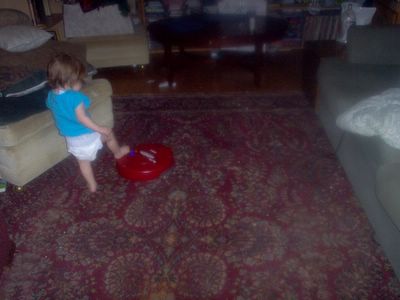
And decides.
She didn't hurt it, and in fact now she's tossing a ball at it, trying to get it to play.

Rosie contemplates what to do with the robotic vaccum cleaner.


And decides.
She didn't hurt it, and in fact now she's tossing a ball at it, trying to get it to play.
Friday, January 27, 2006
Update: Simels Weighs In
As noted below, I scratched my head a bit over Michael Berube's odd posting on the greatest American bands. But my response was nothing compared to that of my friend Steve Simels, who flatly anounces that Berube is, well, wrong.
Steve knows more about music in the latter half of the twentieth century than anyone I know; he's truly an extraordinary resource. Things you need to know about Steve: he was an early and enthusiastic supporter of Patti Smith. He saw Bruce Springsten play to 30 people in like 1973. He's a power pop fan. For many years, he was the house critic for Stereo Review (later Sound and Vision). He can write. And he's one of the most charming, self-deprecating, funny people I know. He's a truly decent human being. And we're the same height.
Oh, and he doesn't post on any blog except Eschaton, which means that I get his input in either short, off-topic posts (sorry, Atrios!) or in emails.
Without further ado, then, Steve Simels on Berube.
FWIW.
Steve knows more about music in the latter half of the twentieth century than anyone I know; he's truly an extraordinary resource. Things you need to know about Steve: he was an early and enthusiastic supporter of Patti Smith. He saw Bruce Springsten play to 30 people in like 1973. He's a power pop fan. For many years, he was the house critic for Stereo Review (later Sound and Vision). He can write. And he's one of the most charming, self-deprecating, funny people I know. He's a truly decent human being. And we're the same height.
Oh, and he doesn't post on any blog except Eschaton, which means that I get his input in either short, off-topic posts (sorry, Atrios!) or in emails.
Without further ado, then, Steve Simels on Berube.
This is bizarre in my opinion. "Can
it be true that there were no 'great'
American bands prior to the late
1970s?"
Uh, short answer?
No.
Forgetting the Velvets (which, generation
gap or not, I think is weird),
the Raspberries,and Big Star....
Let's talk just about the 60s
(thus leaving out the Crickets, among other
worthies). Ten indisputably great American
bands of the 60s? (not counting strictly back
up bands) In no particular order.....
The MC5
The Byrds
The Buffalo Springfield
The Beach Boys
The Blues Project
The Band
Moby Grape
Jefferson Airplane
Creedence Clearwater Revival
The Lovin' Spoonful
Oh, and I forgot such pre-late 70s
American bands like Love,Steely Dan,
and Tom Pettty and theHeartbreakers.
All of whom are as important
(and excellent) as the ones Berube
cites, like the Mats, Husker Du, et al.
FWIW.
Monday, January 23, 2006
Duh, It's Grand Funk....
Noted cultural studies dude and literary critic Michael Berube poses an interesting question: Who is the greatest American rock band, and why is this question so white?
Personally, I'd throw my money behind the 'Mats, if I had to choose from Berube's list here, though The Ramones are obviously more influential. Personally, the Velvet Underground never spoke to me--I always assumed I was born about a decade late. (I heard a radio piece on Nico a month or so ago--bleah.) Like Dylan, I respect the achievement, but it's not something I connect with. Dylan also raises the question of the mistake of not considering individual artists: Bob himself, for example, or Bruce (for whom I think a pretty compelling argument could be made). But if it has to be a band, there's a sidebar here with plenty of red-blooded Americans. Please note the absence of "the various All-Stars of Turgid who named their groups after cities, states, or rivers of Hades."
Your nominees?
I realized that I didn’t have the faintest idea what “alternative” I would offer. Part of the problem, I think, is the term “greatest”: it suggests a longevity and/or a ponderousness that eliminates from consideration groups like the Ramones, who had a tremendous impact on American popular music but are really, in retrospect, three-album wonders. See also Velvet Underground, Television, Modern Lovers, Nirvana. Well, so maybe X? Hüsker Dü? The Replacements? Can it be true that there were no “great” American bands prior to the late 1970s? (Musically, btw, I think the best of these bands was X. Partly that’s because it’s true, and partly it’s because I never completely forgave the Replacements for being such incompetent drunken louts in half their live shows. At least Hüsker Dü showed up and played like they meant it.)
Personally, I'd throw my money behind the 'Mats, if I had to choose from Berube's list here, though The Ramones are obviously more influential. Personally, the Velvet Underground never spoke to me--I always assumed I was born about a decade late. (I heard a radio piece on Nico a month or so ago--bleah.) Like Dylan, I respect the achievement, but it's not something I connect with. Dylan also raises the question of the mistake of not considering individual artists: Bob himself, for example, or Bruce (for whom I think a pretty compelling argument could be made). But if it has to be a band, there's a sidebar here with plenty of red-blooded Americans. Please note the absence of "the various All-Stars of Turgid who named their groups after cities, states, or rivers of Hades."
Your nominees?
Saturday, January 21, 2006
PPPDA: Editorial, Bomp! #18
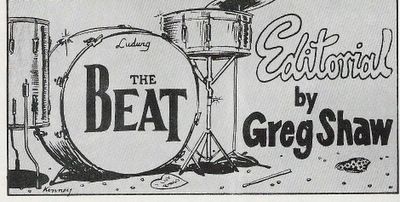
This is a really interesting time capsule of reasoning concerning what Greg Shaw saw as the inevitability of Powerpop. There are some curious underlying assumptions, but I like his broader argument about the pendulum of the music scene. Why, though, do we think he misread the path of punk so dramatically? Very curious.
The graphics are original.
From Bomp! # 18, March 1978, Special Issue on PowerPop.
.
.
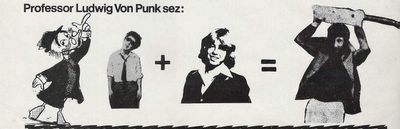
I believe that this is Richard Hell + Leif Garrett = Pete Townsend, but I'm not sure. A little help?
The graphics are original.
From Bomp! # 18, March 1978, Special Issue on PowerPop.
.
Welcome to BOMP #18. In this issue, we're going to do something few rock magazines have ever done; something so audacious, so presumptuous, that we'd never even dream of doing it if not for the fact that we've already been doing it for 8 years and this is no time to stop! That's right, we're going to totally ignore what's going on in the center ring of the rock arena, and cast our gaze over to the wings where the next act is warming up...
In musical terms, of course, there is seldom the kind of abrupt change from one thing to another that would make it easy to perceive trends in clear sequence. Rather, a new trend starts as a rumbling at the fringe, builds gradually to a peak over a year or two, then slowly fades. Right now a good half-dozen trends are variously rising or falling, but that doesn't concern us here. We're more interested in the latest rumbling; it started a few months ago, and now it even has a commonly accepted name: Powerpop.
The term is not new; you hear it more and more these days, as though people were looking for a way to describe something, and each hitting on it spontaneously. But like "punk rock" a year or two ago, it's used so loosely that it has no real meaning. I happen to think it has, or ought to have, a very definite meaning, because to me—again, like punk rock—a record either has it or it doesn't, and by making the effort to define it, we can maybe understand what makes it unique, giving us all a better handle on what exactly is behind this trend.
Trend? Perhaps it's a little premature to be talking about what will be coming after punk rock, when punk itself has barely begun to dent the edges of America's fossilized musical consciousness. The best punk records are only just now being heard, and the best groups only starting to get the recognition they deserve, so the last thing I want to do is deflate their sails. But as your faithful pop commentator, I must report what I observe... .
OBSERVATION #1: Things are changing. Fast.
Our notion of the rate of change in pop is based on having just lived through 8 of the most sluggish, static years in history. In fact, this is an abnormal condition. When pop is healthy, things happen so fast that no one can keep up. Consider the Beatles. From the release of "I Want to Hold Your Hand" to the recording of Sgt. Pepper was around three years. In that time, they had about 15 albums released, went through at least 3 periods in their music—each of which changed the world completely and inspired thousands of imitations—and while this was happening, the surfing trend reached its peak, turned into hot rod music, inspired folk-rock, which led into and coexisted with punk rock, all of which then metamorphosed into acid rock and flower power, while at the same time white kids had discovered blues and founded a whole school based an that hybrid, along with the beginnings of other forms of eclectic rock and art rock, in America, England, Australia and Europe.... And that's just the major trends of 1964-67! The number of interesting, collectible rock records from this period is probably well in excess of 10,000, but nobody knows for sure—too many classics, overlooked in all the hysteria of the time, are still turning up.
The thought is somewhat staggering when you consider it, but this I believe to be the normal state of pop. Obviously, despite all the excitement and activity that's been brought into the pop scene by the New Wave, this is only the beginning. It's been 2 years since.punk rock got strongly underway, and in that time not more than 300 records, in the broadest definition of New Wave, have come out.
The pace is picking up, with a sort of snowball effect. It would be foolish to think that we'll have another 2 years of the same kind of punk rock that's fashionable now.
Observation #2: Punk rock can only go so much further.
Punk rock as we know it today was created with a built-in obsolescence. It was a form of shock treatment, a necessary therapeutic stage between the lobotomized atrophy of the early '70s and the kind of healthy organism pop will hopefully be by the early '80s. It served, to switch metaphors, as our battering ram into the fortress where the idiot prince has been hoarding the dead King's wealth. Like a battering ram, its purpose was to concentrate tremendous force an a narrow point, to drive a wedge through rotting timbers. It's served that function well. The qualities we loved it for—loudness, deliberate stupidity, calculated offensiveness, violent rejection of everything passe and boring—helped it make the dramatic break with early '70s rock culture that was so necessary, brought the media coverage that spread the rhetoric that recruited more and more kids to the movement, all that and more. But those same qualities gave it a limited lifespan. A lot of people now are tired of hearing the same "one chord wonders" do the same thing, record after record. I don't mean the acts like the Ramones who write songs you can identify with and care about over the years; I mean all the anonymous new bands a greedy industry, mainly in England, has rushed onto vinyl. There is a glut of second-rate product that's driving this stage of the movement to a rapid close.
OBSERVATION #3: An awful lot of the new, unrecorded bands one sees in clubs or hears on demo tapes these days are moving away from the established punk sound, toward a more pop approach.
It's dangerous to give out these tricks of the trade to the initiated, but I'll tell you this one: the easiest way to spot a new trend a year or two before it breaks is to look at the most interesting new groups making the rounds of the street scene, and see what they have in common. While the record industry is asking itself whether New Wave will be a passing fad, we laugh because we know that every young musician starting up a band in 1977 dreams of joining the New Wave, and we also know that each succeeding wave, new ideas, new trends come in.
* * *
Now let's examine another aspect of this emerging trend called Powerpop. Like, why is it happening? We know by now (see editorial on Rock Theory last issue) that nothing happens randomly; there are historical forces at work, in rock as in everything. Let’s go back to the dialectical theory of rock history explored in my BOMP #13 editorial, which suggested that within rock there are polar extremes that beget their opposites in a never-ending cycle. At one end hard rock: raw, powerful, rebellious, straight off the streets. And at the other, pop” clean, studio-crafted artifice, light, unthreatening. There's no suggestion of "good" or "bad" here—a choice between the Bee Gees and The MC5 would be meaningless, except in terms of personal taste.
My feeling has always been that the best music comes toward the center of the pendulum's swing, when rock contains strong elements of pop; and pop of rock. Example: Olivia Newton-John is pop, and so is Abba. Black Sabbath is rock, and so is The Move. Some are so right-down-the-middle that neither approach predominates: Raspberries, Badfinger, Beatles, Dwight Twilley. For some reason, such artists are my enduring favorites.
It's no mystery of course; if both approaches have qualities of merit, then combining the best aspects of each should logically produce a superior product. But human beings are not always so rational informing their musical tastes, and Program Directors seem to insist human beings actually like records that combine the worst elements of two or more musical styles (turn on your radio right now and verify this).
We've traced how in the late '60s the rise of "underground" music and media led to the exaltation of the rock extreme, while pop was condemned and virtually eliminated except when it crept into the work of already-accepted artists like the Beatles. It was possible to maintain the pretense of a complete rock culture without pop because of the diversity even within one extreme: rock encompasses everything that is loud and heavy as well as everything spontaneous, free-form, jazz-influenced. Everything from Ten Years After to Mahavishnu. And at the same time, there was one form of pop allowed in: country-rock. So the pop quotient was filled by the likes of John Denver, Linda Ronstadt and James Taylor. Most of this was as light and ephemeral as any other pop, but they called it "mellow" and, well, we all know what was wrong there.....
This phase hit its peak in 1969-71 when all we had was heavy metal on the one hand and mellow moods on the other, with hardly anything in between. In 1972, observing this, I began suggesting a return of the pendulum to the middle ground, and called it the '70s Pop Revival. Indeed, groups like the Raspberries and Badfinger were then providing superb, examples of what '70s rock could be with the proper injection of pop consciousness; as did the glitter bands which came out of England the following year. The story of these bands and what went wrong with their movement will be told elsewhere in this issue. For now, if we grant that a Mod-Pop trend of some sort was afoot in '73-'74, and continued well into the early stages of Punk (the New York scene was moving strongly toward mod fashion when the Punk style of Johnny Rotten/Richard Hell took over abruptly some time last year), and bands like the Flamin' Groovies were at the forefront of the European new wave until about the same time, it can be seen that the Punk explosion was really an untimely interruption of another movement that was already well underway.
Let's consider that possibility. The Mod-Pop revival was in accordance with rock theory and historical trends. Punk Rock, as we saw last issue, was created consciously by a relatively small number of fanzine-influenced people, and is indeed the first example of a trend that was deliberately launched by rock fans. This explains why it made its appearance “out of sequence” as it were. If this be the case, what ought to happen as the initial mania of punk rock dies out is that the Mod-Pop revival will resume, incorporating the most valuable elements of punk. The result will be late '70s Powerpop.
Here's something else to think about. The reason 10,000 records by rock groups were issued during the years of Beatlemania is because the record industry saw profits there. For a record to come out, somebody has to put it out, and although independent recording today is a viable alternative, the floodgates won't open for New Wave music until some of the groups starting having hits. Big hits. Every record company in the world is poised to throw everything they've got into the New Wave at the first sign of this. And let's face it, the really big hits are not going to be two-chord records about tearing down the British social system. Really hard rock has never had the mass-commerciality of pop, and it will be acts like the Ramones, the Jam, the Boys, Dwight Twilley, 20/20, Cheap Trick, etc., who will crack the charts and have the first hits. Radio wants to play New Wave records but they don't want to offend their mass audience with crude, obnoxious music. They're waiting for Powerpop. And so are the kids of America—all 40 million of them.
Let's give it to them......

.
I believe that this is Richard Hell + Leif Garrett = Pete Townsend, but I'm not sure. A little help?
Friday, January 20, 2006
Friday Babyblogging
These aren't brand new: the first is from Thanksgiving and the second from Christmas. But Grandma just sent them along this week, and after doing heroic battle with the scanner (which I had to completely uninstall and reinstall), things seem to be working okay. Look for some more PPPDA stuff this week, now that the scanner is repaired. Without further ado: Babyblogging.
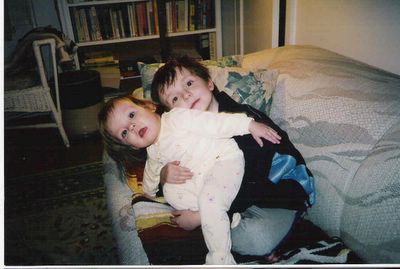
Brother and sister.
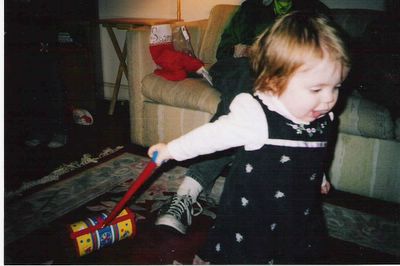
With Christmas toy.

Brother and sister.

With Christmas toy.
Wednesday, January 18, 2006
How Rude!
Courtesy of Atrios, who asserts that if we were to set The Rude Pundit to music it might sound something like this, comes the, err, folk singer Hamell on Trial:
Another great line: "I used to be disgusted/ Now I'm pissed," which I think does a nice job of turning the pop irony of Elvis Costello into righteous anger. "Amused" was back when "That's My Bush!" was on TV, when he was a harmless buffoon we could tolerate because of the surpluses and complacency fostered by the Clinton Administration. "Amused" died on 9/11. Now we have "pissed."
Look, the anger is growing out there. Maybe the TV talking heads think it's just "left-wing whackjobs," but it isn't. Every guy who gets stop-lossed, every grandmother who can't figure out Plan fucking D, every factory worker who sees their job shipped to Bangalore.... this is righteous anger, and painting the angry as latte-drinking (or chardonnay-drinking, or sushi-eating, or tree-hugging, or Che-Guevara-t-shirt-wearing) doesn't make the anger go away. It may delay the recognition that we're on the same side, but that's all it will do: delay it.
I like righteous anger. It gets things done.
WARNING: Atrios link NOT work-safe.
You take the low road, I'll take the lower road
You've met your match
I admit I get a kick out of talkin' 'bout
Coulter's snatch
(would that be like this, perhaps?)
Another great line: "I used to be disgusted/ Now I'm pissed," which I think does a nice job of turning the pop irony of Elvis Costello into righteous anger. "Amused" was back when "That's My Bush!" was on TV, when he was a harmless buffoon we could tolerate because of the surpluses and complacency fostered by the Clinton Administration. "Amused" died on 9/11. Now we have "pissed."
Look, the anger is growing out there. Maybe the TV talking heads think it's just "left-wing whackjobs," but it isn't. Every guy who gets stop-lossed, every grandmother who can't figure out Plan fucking D, every factory worker who sees their job shipped to Bangalore.... this is righteous anger, and painting the angry as latte-drinking (or chardonnay-drinking, or sushi-eating, or tree-hugging, or Che-Guevara-t-shirt-wearing) doesn't make the anger go away. It may delay the recognition that we're on the same side, but that's all it will do: delay it.
I like righteous anger. It gets things done.
WARNING: Atrios link NOT work-safe.
Sunday, January 15, 2006
Worse and Worser.
Okay, two stupid theme things.
I actually don't think "Hooked on a Feeling" is the worst song ever--I mean we live in a world which has elevated "Rico Suave" "The Macarena" and "Mmmm-bop" to the stratosphere--but this version is kinda horrifying--and the video is even worse.
And I'm Baywatch Hasselhof, thank you very much.
One.
And
Two.
I actually don't think "Hooked on a Feeling" is the worst song ever--I mean we live in a world which has elevated "Rico Suave" "The Macarena" and "Mmmm-bop" to the stratosphere--but this version is kinda horrifying--and the video is even worse.
And I'm Baywatch Hasselhof, thank you very much.
There Are Days I Wish I Were Paris Hilton....
Not because I'm a skank, and not because I want to leave my lovely family, but because if I were an unattached jet-setter with all the money in the world, I could make something like this:
But I still wouldn't do things like this.
As previously reported, the "United Sounds of ATP" festival will take place on the two consecutive weekends of May 12-14 and May 19-21, and will feature a different curator for each of the festival's six days. Mudhoney, the Yeah Yeah Yeahs, and Devendra Banhart will helm the first weekend, while the second weekend will be spearheaded by the Shins, Sleater-Kinney, and Dinosaur Jr.
So far, Mudhoney have picked Black Mountain, Comets on Fire, the Drones, the Scientists, Country Teasers, and David Dondero for May 12 performances. The Yeah Yeah Yeahs have chosen TV on the Radio, Liars, Ex Models, Blood Brothers, Celebration, Imaginary Folk, and the Tall Boys to rock May 13. Rounding out the first weekend on May 14 will be Banhart's choices: Espers, Vetiver, Jana Hunter, Bat for Lashes, and the Metallic Falcons. Don't forget that all of the curators will play their own sets on their respective days, if you're keeping score at home.
Weekend Two's not so filled yet, but hey, Dinosaur Jr. just got the gig. The Shins and Sleater-Kinney must just be slackers. The Shins, who will helm May 21, have only signed up the New Pornographers, setting the stage for an indie-pop clash of the titans. Sleater-Kinney have recruited the Gossip, as well as David Cross as their MC, for May 20.
But I still wouldn't do things like this.
Subscribe to:
Posts (Atom)